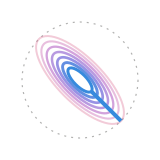
PnrArray
Multiplexed threshold array: POVM, threshold limit, PNR limit
11/11 passed in 72ms
| Test | What it does | Result |
|---|---|---|
test_array_click | At one element the array POVM reproduces click_prob across efficiency, dark count and coherent-state flux. | ✅ pass |
test_array_coherent | Folding the POVM against a Poisson photon-number distribution agrees with the closed binomial count a balanced splitter gives directly. | ✅ pass |
test_array_complete | The array's elements sum to the identity on the truncated space and each one is positive semi-definite. | ✅ pass |
test_array_converge | Doubling the element count halves the deficit from true photon-number resolution, which is first order in 1/N with coefficient | ✅ pass |
test_array_dark | On vacuum the array reports a binomial count over its elements. | ✅ pass |
test_array_distinct | At unit efficiency the probability of reporting the true number is exactly pnr_distinct, the probability that no two photons share a bin. | ✅ pass |
test_array_efficiency | The no-click probability falls monotonically with element efficiency and is exactly zero at unit efficiency on three photons. | ✅ pass |
test_array_elements | The probability of reporting the true photon number rises monotonically with the element count, at fixed per-element efficiency. | ✅ pass |
test_array_inclusion | The occupancy recursion agrees with the closed inclusion-exclusion form of the same POVM, evaluated in exact rationals. | ✅ pass |
test_array_threshold | At one element the no-click element is (1 - d)(1 - eta)^n on the Fock diagonal. | ✅ pass |
test_array_vacuum | The no-click element is (1 - d)^N (1 - eta)^n at every element count. | ✅ pass |